



Likewise, the Spirit also helps our weaknesses, for we don’t know how to pray as we ought. But the Spirit himself makes intercession for us with groanings which can’t be uttered. – Romans 8:26
There are moments when prayer becomes impossible.
Not because faith has failed.
Not because the heart has grown cold.
Not because God has moved away.
Sometimes prayer becomes impossible because the soul has reached a depth language cannot enter.
A mother longs for a child and has no words left.
A king collapses under the weight of guilt and grief.
Jesus kneels in Gethsemane, where sorrow becomes agony.
A desperate woman reaches for the hem of His garment without saying a word.
Nehemiah stands before a king and has only one instant to pray.
And Paul tells us that when we do not know how to pray, the Spirit intercedes with groanings too deep for words.
This is not an exception to prayer. It is one of Scripture’s hidden patterns.
The Bible does not present prayer as a polished speech performed for God. It presents prayer as the honest movement of the heart toward God. Sometimes that movement has words. Sometimes it has tears. Sometimes it has silence. Sometimes it has groaning. Sometimes it is nothing more than a trembling hand reaching through a crowd.
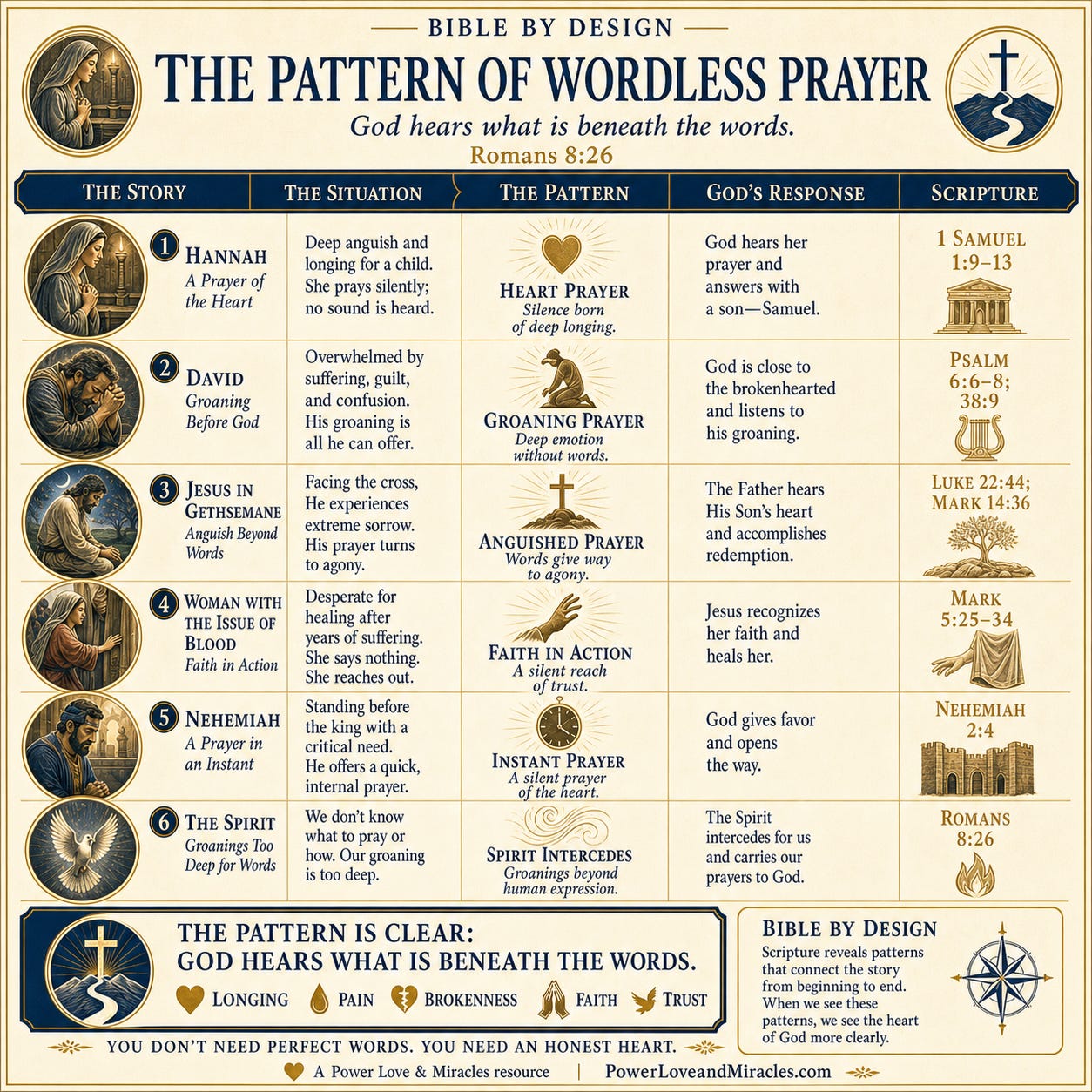
The pattern is clear: God hears what is beneath the words.
Hannah: When Longing Becomes Prayer
Hannah’s prayer in 1 Samuel 1 is one of the most tender examples of wordless prayer in Scripture.
She longs for a child. She carries years of grief, disappointment, and provocation. When she finally comes before Yahweh at Shiloh, her pain is so deep that her lips move, but no sound comes out.
Eli sees her and misunderstands. He assumes she is drunk. But Hannah is not drunk. She is pouring out her soul before the Lord.
That phrase matters. Hannah is not merely reciting a request. She is not performing religious language. She is bringing the full ache of her life into the presence of God.
Her prayer is silent, but it is not empty.
God hears her. And from that silent prayer comes Samuel, one of the great prophetic figures in Israel’s story.
A prayer no one else could hear became part of the turning of a nation.
Hannah teaches us that silence before God is not prayerlessness. Sometimes silence is the deepest speech of the soul.
David: When Pain Becomes Groaning
David gives us another form of wordless prayer: groaning.
In Psalm 6, David says he is weary with groaning. Every night he floods his bed with tears. In Psalm 38, he speaks of guilt, weakness, sorrow, and anguish.
Then he says this: Lord, all my desire is before you. My groaning is not hidden from you. – Psalm 38:9
That line belongs at the center of this pattern.
David does not say, “My explanation is clear to you.” He says, “My groaning is not hidden from you.”
Groaning is what happens when pain has sound but not syntax. It is the voice of suffering before it becomes a sentence. It is the soul pressing upward through the body.
Many believers edit their prayers too carefully. We try to bring God our acceptable emotions while hiding the ones that feel too raw, too angry, too confused, or too unfinished.
But David teaches us to bring the groan.
Bring the ache before it becomes insight.
Bring the sorrow before it becomes testimony.
Bring the confusion before it becomes clarity.
God is not offended by the sound of a soul in anguish. David’s groaning is not hidden from God.
Neither is yours.
Jesus: When Anguish Becomes Surrender
The pattern reaches its holiest depth in Gethsemane.
Jesus enters the garden knowing the cross is near. He tells His disciples that His soul is deeply grieved, even to death. He falls to the ground and prays. Luke tells us His agony becomes so intense that His sweat falls like great drops of blood.
Jesus does speak in the garden: Abba, Father… not what I desire, but what you desire.
But His prayer is more than words. His whole body enters the prayer. His sorrow, sweat, trembling, and surrender all become part of His communion with the Father.
This matters deeply.
Gethsemane shows us that anguish is not the opposite of faith. The most faithful human life ever lived included sorrow, agony, and surrender.
Prayer does not always remove the cup. Sometimes prayer brings the heart into communion with the Father while the cup remains.
Jesus teaches us that when words give way to agony, the Father still hears.
The Woman with the Issue of Blood: When Reaching Becomes Prayer
In Mark 5, a woman who has suffered for twelve years hears about Jesus. She has spent everything. She has endured much. She has grown worse instead of better.
She comes behind Jesus in the crowd and touches His garment.
No public speech.
No formal request.
No carefully worded prayer.
Just a reach.
But the reach is prayer. It is faith taking bodily form.
Jesus stops and asks, “Who touched my clothes?” The disciples are confused because the whole crowd is pressing around Him. But Jesus knows the difference between being bumped by the crowd and being touched by faith.
The woman comes forward trembling and tells Him the whole truth.
Jesus does not shame her. He calls her “Daughter.” He tells her that her faith has made her well and sends her in peace.
Her silent reach is recognized as faith.
That is good news for everyone who comes to God without confidence, without polished language, without strength to explain everything.
Sometimes faith does not sound like a prayer. Sometimes faith simply reaches.
And Jesus recognizes the reach.
Nehemiah: When One Instant Becomes Prayer
Nehemiah gives us the prayer of a critical moment.
He stands before the Persian king, carrying grief over Jerusalem’s broken walls. The king notices his sadness and asks what he wants.
This is dangerous. Nehemiah cannot pause for a long devotional prayer. He cannot step away to gather his thoughts. He has one moment.
Nehemiah 2:4 says: So I prayed to the God of heaven. I said to the king…
That is all.
A prayer, then an answer.
The content of the prayer is not recorded. It may have been only one word: “Help.” It may have had no words at all. But before Nehemiah speaks outwardly to the king, he turns inwardly to the God of heaven.
This is instant prayer. And it is not shallow because it is brief.
Some of the most important prayers of our lives happen in seconds.
Before walking into a hospital room.
Before answering a difficult question.
Before sending a hard message.
Before responding to criticism.
Before making a decision that matters.
A silent inward prayer can reorient the soul. It can interrupt reactivity. It can open space for wisdom, courage, restraint, and favor.
Nehemiah teaches us that one honest Godward breath can become prayer.
The Spirit: When We Do Not Know How to Pray
Romans 8 brings the whole pattern to its deepest theological meaning.
Paul says creation groans.
Believers groan.
And then he says the Spirit helps us in our weakness.
We do not always know how to pray as we ought.
That admission is a mercy.
Paul does not shame believers for not knowing what to say. He does not pretend mature Christians always have spiritual clarity. He tells the truth.
Sometimes we do not know how to pray. And in that very place, the Spirit helps.
The Spirit intercedes with groanings too deep for words.
This means wordless prayer is not merely human weakness. It is also divine participation. The Spirit meets us at the place where language breaks down and carries our prayer into the heart of God.
Hannah shows us silent longing.
David shows us groaning sorrow.
Jesus shows us anguished surrender.
The woman shows us faith reaching without speech.
Nehemiah shows us instant inward dependence.
Romans 8 shows us that beneath all faithful prayer, the Spirit is helping us.
We are not abandoned when we cannot pray.
We are being carried.
The Pattern Is Clear
The Bible gives us many kinds of prayer.
Spoken prayer.
Written prayer.
Sung prayer.
Corporate prayer.
Confessional prayer.
Intercessory prayer.
But it also gives us wordless prayer.
Longing can pray.
Groaning can pray.
Anguish can pray.
Reaching can pray.
An instant can pray.
And when we cannot pray, the Spirit prays in us and for us.
So when words fail, do not assume prayer has failed.
When all you can do is sigh, sigh toward God.
When all you can do is weep, weep before God.
When all you can do is reach, reach for Christ.
When all you can do is pause for one breath, let that breath turn heavenward.
And when you cannot even do that, trust the Spirit who helps you in your weakness.
You do not need perfect words. You need an honest heart. And even that honest heart is being held by grace.
Carry This Prayer With You
Breathe in: God hears my heart…
Breathe out: … even beneath my words
Bible by Design
Scripture reveals patterns that connect the story from beginning to end. When we see these patterns, we see the heart of God more clearly.
And in this pattern, the heart of God is wonderfully clear:
God hears what is beneath the words.
© 2026 Power Love & Miracles. All rights reserved. Bible by Design™ is a Power Love & Miracles teaching series.
Most excellent and encouraging!