


Romans 8 is one of the most beloved chapters in the Bible, and for good reason. It gives language to suffering, hope, weakness, prayer, sonship, and glory. It steadies people who are weary. It lifts the eyes of people who feel trapped in the present moment.
But Romans 8 is doing more than comforting believers.
It is drawing on one of the deepest redemptive patterns in all of Scripture: the Exodus.
This is not merely a loose comparison or a passing echo. Paul is presenting the life of the Spirit, the groaning of creation, and the future glory of the children of God in a way that recalls Israel’s movement from bondage to freedom, from oppression to inheritance, from groaning to glory.
That is what this first Bible by Design™ piece is meant to show.
This is a Typology Mirror: a visual and theological way of placing two passages or story-patterns side by side so their shared movement becomes easier to see. Sometimes Scripture repeats language. Sometimes it repeats structure. When it does, it often reveals something deeper than a theme. It reveals design.
The Exodus was never only about getting Israel out of Egypt. It revealed the shape of redemption itself.
Romans 8 shows that same shape opening outward until it includes not only a nation, but all creation.
What is a Typology Mirror?
A typology mirror is not about forcing two passages to say the exact same thing. It is about recognizing that God often works through recurring redemptive patterns.
An earlier act of God becomes a kind of pattern or frame for understanding a later one.
In this case, the Exodus functions as a foundational pattern:
bondage
groaning
divine intervention
leading presence
wilderness tension
inheritance ahead
Romans 8 takes that same movement and applies it on a much larger scale. The result is amazing. Paul is not only talking about individual spiritual encouragement. He is talking about creation-wide redemption in the shape of the Exodus.
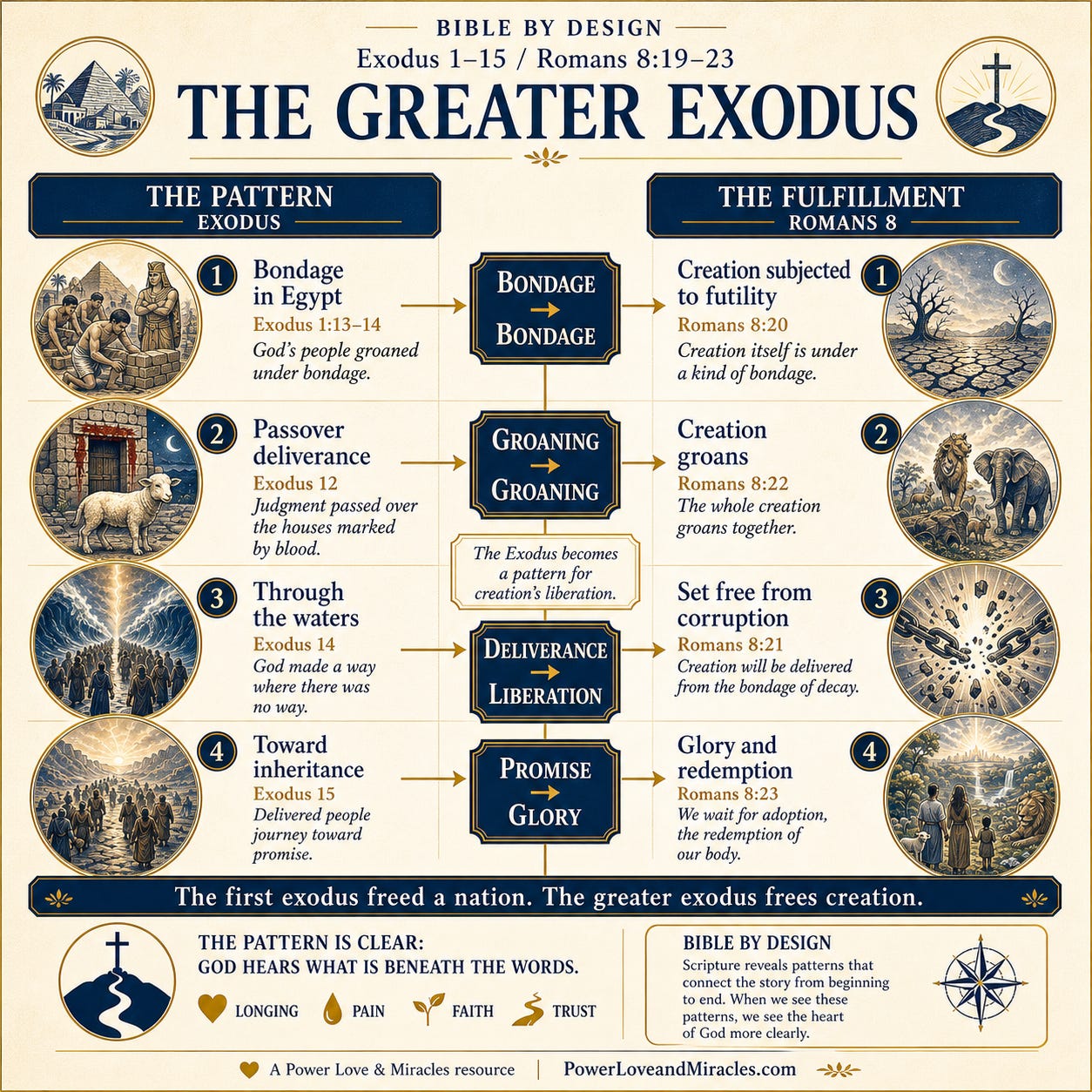
1. Bondage and Futility
The Exodus begins with bondage.
Israel is not free. They live under a power they cannot defeat by their own strength. Pharaoh’s rule is harsh, demanding, and dehumanizing. Their lives are narrowed by slavery.
Romans 8 opens a similar horizon, though on a wider scale. Paul says that creation has been subjected to futility. The word carries the sense of frustration, frustration built into the present condition of the world. Things do not fully become what they were meant to be. Decay is real. Disorder is real. Something is wrong in the present creation.
That does not mean creation is evil. It means creation is burdened. It is not at rest. It is not yet free.
The Exodus gives us a picture of what bondage feels like in history. Romans 8 tells us that the whole created order lives under a comparable condition of frustration and limitation as it waits for liberation.
That is the first major mirror.
Egypt is to Israel what futility is to creation: a condition of constrained life, a state in which something made for more is held under something less.
2. Groaning Before Deliverance
One of the clearest links between the Exodus and Romans 8 is groaning.
In Exodus, the people of Israel groan under their slavery. Their cry rises up to God. Their suffering is not hidden, and their groaning is not meaningless. It is heard.
In Romans 8, Paul says that the whole creation groans. Then he adds that we ourselves groan within ourselves as we wait for the redemption of our body.
That is deeply important.
Groaning in Scripture is not always a sign of unbelief. Often it is the sound made by those who are caught between promise and fulfillment. It is the sound of pain that has not yet been healed, longing that has not yet been satisfied, and hope that has not yet become sight.
The groaning of Israel in Egypt did not mean God had abandoned them. It meant their need had reached the point where deliverance was about to take visible shape.
Romans 8 gives the same dignity to our groaning. Creation groans. Believers groan. This present age is still marked by tension. But the groaning exists inside a redemptive story, not outside of it.
That matters pastorally.
Many people assume that if they were truly spiritual, they would not groan. But Romans 8 says otherwise. Groaning is not proof that the story is failing. Sometimes it is the sound heard at the threshold of freedom.
3. The Leading Presence of God
In the Exodus story, God does not merely liberate His people and leave them to fend for themselves. He leads them.
The pillar of cloud and fire is not decorative. It is the sign of God’s active presence guiding a people through a place they could not navigate alone.
That same emphasis appears in Romans 8 in a transformed but unmistakable way: “For as many as are led by the Spirit of God, these are children of God.”
That line carries Exodus weight.
God’s people are still a led people. Redemption is not only rescue from something; it is guidance into something. The people of God are not self-created, self-directed, or self-delivered. They are led.
This is one of the most beautiful continuities in the mirror.
In Exodus, the people are led through wilderness by the visible presence of God. In Romans 8, the children of God are led through the tensions of this present age by the Spirit of God.
The means of guidance has deepened. The intimacy has intensified. But the pattern remains.
The redeemed are led.
4. Sonship, Belonging, and Inheritance
The Exodus is not merely a liberation story. It is a belonging story.
God does not simply say, “Let the slaves go.” He says, in effect, “These are My people.” Israel is brought out to become a covenant people, a people who belong to God in a distinct and relational way.
Romans 8 intensifies this even further. Paul says we have not received the spirit of bondage again leading to fear, but the Spirit of adoption by whom we cry, “Abba, Father.”
That is a stunning turn.
Exodus moves from slavery to covenant belonging. Romans 8 moves from bondage to adoption and sonship. And then Paul presses further: if children, then heirs.
That means the Exodus pattern is not only about escape from oppression. It is about identity. It is about being brought into filial relationship and future inheritance.
Israel was not rescued merely to stop suffering. Israel was rescued to belong.
Believers are not freed merely to feel relief. We are brought into the life of the Father.
And like Israel heading toward the promised inheritance, the children of God in Romans 8 are also moving toward something not yet fully possessed. The story is still forward-facing.
5. Wilderness Tension and Present Suffering
Exodus is not a straight line from liberation to rest.
There is a wilderness.
That is where many readers miss the power of the parallel. Deliverance does not erase tension immediately. After the crossing comes hunger, thirst, testing, fear, memory, resistance, and formation. The people have been brought out, but they are still being shaped.
Romans 8 carries that same emotional and spiritual terrain. Paul does not pretend that life in the Spirit eliminates suffering. In fact, he says plainly that we suffer with Christ in order that we may also be glorified with Him.
That is wilderness language in theological form.
The wilderness is the place between rescue and inheritance. It is the place where people are no longer what they were, but not yet fully where they are going. It is the place where dependence deepens, identity is tested, and presence matters more than comfort.
Romans 8 meets us there.
This chapter is so powerful because it refuses shallow optimism. It does not deny suffering. It relocates it. It places suffering inside the journey of redemption instead of treating it as evidence that redemption has failed.
That is one of the deepest gifts of the Exodus mirror.
It reminds us that present tension is not necessarily contradiction. Sometimes it is the terrain of transformation.
6. Redemption Not Yet Complete
In Exodus, liberation begins decisively, but the story is not complete in a single moment.
There is an already and a not yet.
The people are truly delivered, yet still traveling. They are no longer slaves, yet not yet settled. The promise is real, but not fully possessed.
Romans 8 carries the same structure. Believers have the firstfruits of the Spirit, yet still wait for the redemption of the body. Creation itself waits. Hope waits. The children of God wait.
This is critical to the theology of the chapter.
Paul is not describing wishful thinking. He is describing Spirit-informed waiting. The firstfruits mean the future has already begun to enter the present, but the present has not yet been fully transformed by that future.
That is exactly what the Exodus helps us understand.
Israel’s deliverance was real before the journey was over. The promise was true before the inheritance was possessed. Likewise, in Romans 8, redemption is real even while its fullness is still awaited.
This protects us from two opposite errors.
It keeps us from despair, because the work of God has already begun.
And it keeps us from triumphalism, because the fullness is still ahead.
7. Glory Ahead
The Exodus story moves toward a destination.
It is not aimless wandering, even when it feels slow. The journey has a horizon: promise, rest, inheritance, nearness, and the establishment of a people who live under the blessing and presence of God.
Romans 8 also moves toward a horizon, and Paul names it with one of the great words of Scripture: glory.
“The sufferings of this present time are not worthy to be compared with the glory which will be revealed toward us.”
That line is not detached from the Exodus pattern. It is its transfiguration.
Exodus moves toward a location. Romans 8 moves toward the liberation of creation, the revealing of the children of God, the redemption of the body, and the full manifestation of divine glory.
In both cases, the story is not just about what we are leaving behind. It is about what we are being brought into.
That is one of the great redemptive instincts of Scripture. God does not merely remove bondage. He leads toward fullness.
In Romans 8, that fullness is so expansive that creation itself is caught up in it.
The horizon has widened from national deliverance to cosmic renewal.
The Great Expansion of the Pattern
This may be the most important insight in the whole mirror: Romans 8 does not merely repeat the Exodus. It expands it.
What happened to Israel in history becomes a pattern for understanding what God is doing in Christ through the Spirit on a creation-wide scale.
The bondage is wider.
The groaning is wider.
The hope is wider.
The inheritance is wider.
The glory is wider.
The Exodus revealed the way God redeems. Romans 8 reveals that same redemptive logic filling the whole horizon of creation.
That is why this chapter feels so immense. It is personal, but never merely private. It comforts the believer, but it does so by placing the believer inside the largest possible frame: the renewal of all things under the purpose of God.
Why This Matters
This matters because many of us read Romans 8 as if it were speaking only to our internal emotional life.
It certainly speaks there. It steadies fear. It strengthens hope. It teaches trust. But Paul is doing something much larger. He is telling us that our suffering, our waiting, our prayer, and our hope all exist inside a redemption story that has the shape of the Exodus and the scale of new creation.
That means your groaning is not random.
Your waiting is not meaningless.
Your present weakness is not proof of abandonment.
The Spirit still leads the people of God. The inheritance is still ahead. Glory is still the destination.
And creation itself is not forgotten.
What This Means to You
If you are in a season where life feels more like wilderness than arrival, Romans 8 offers more than reassurance. It offers orientation.
It reminds us that God often leads His people through places that feel unfinished. The presence of groaning does not mean the absence of God. The experience of waiting does not mean the promise has failed.
The Exodus tells us that God hears the cry of the burdened. Romans 8 tells us that even now, in a groaning creation, the Spirit is at work, the children of God are being led, and glory is coming.
Creation is waiting.
But it is not waiting aimlessly.
It is waiting inside a pattern of redemption already written into the Scriptures from the beginning.
The God who brought His people out of bondage is still leading them toward glory, and this time the horizon is as wide as creation itself.
If this Bible by Design typology mirror helped you see Romans 8 in a new way, listen to this week’s episode of The Bible Unplugged: TBU 86 — “Creation is Waiting.”
This is the first in a new Bible by Design series exploring the deep architecture of Scripture through visual theology, structural echoes, and redemptive patterns hidden in plain sight.
© 2026 Power Love & Miracles. All rights reserved. Bible by Design™ is a Power Love & Miracles teaching series.
This is awesome and well done!